
- Home
Edition
Africa Australia Brasil Canada Canada (français) España Europe France Global Indonesia New Zealand United Kingdom United States Edition:
Global
Edition:
Global
- Africa
- Australia
- Brasil
- Canada
- Canada (français)
- España
- Europe
- France
- Indonesia
- New Zealand
- United Kingdom
- United States
Academic rigour, journalistic flair
 komokvm/Shutterstock
Child poverty: how bad is it in the UK?
Published: December 17, 2025 5.34pm GMT
Regina Murphy Keith, University of Westminster
komokvm/Shutterstock
Child poverty: how bad is it in the UK?
Published: December 17, 2025 5.34pm GMT
Regina Murphy Keith, University of Westminster
Author
-
 Regina Murphy Keith
Senior Lecturer in Food, Nutrition and Public Health, University of Westminster
Disclosure statement
Dr. Regina Murphy Keith is affiliated with the World Public Health Nutrition Association a registered charity for nutritionists and she is a Commissioner on the UK RIght to Food Commisssion
Partners

University of Westminster provides funding as a member of The Conversation UK.
View all partners
DOI
https://doi.org/10.64628/AB.43gjkjhav
https://theconversation.com/child-poverty-how-bad-is-it-in-the-uk-271692 https://theconversation.com/child-poverty-how-bad-is-it-in-the-uk-271692 Link copied Share articleShare article
Copy link Email Bluesky Facebook WhatsApp Messenger LinkedIn X (Twitter)Print article
The UK government recently unveiled its child poverty strategy, with the removal of the two-child limit on benefits payments as the centrepiece.
What’s sobering is how desperately the UK needs a strategy to address child poverty. At the end of 2024, four and a half million children – 31% of all UK children – were in relative poverty, meaning that they live in households earning less than 60% of the UK’s median income.
And 18% of all children were growing up in food-insecure households, without consistent access to nutritious food.
Ladywell, in Birmingham, has the highest levels, with 62% of children living in relative poverty. In some areas of Leeds, London, Bradford, Manchester and Liverpool over half of children live in poverty. Nearly half of Asian British and Black British children are in poverty, as are 43% of children in single-parent families.
This problem isn’t limited to the UK. Research by Unicef found that 23% of the children in 37 surveyed high-income countries live in poverty. But while relative poverty in these countries declined by an average of 2.5% between 2013 and 2023, in the UK it rose by 34%.
Within the UK, Scotland reduced child poverty in 2025, thanks to policies such as the monthly Scottish child payment of £27.15 for all children under 16. Payments also go to those expecting a baby and during the baby’s first year of life, to support the health and nutrition of mothers and infants.
One in five Scottish children still live in poverty, but Scotland has kept child poverty levels stable in the last decade.
In England, policies such as the two child limit and the cap on total benefits payments, combined with reductions in spending, have led to rising levels of child poverty. Unicef estimate that as these there has been a real terms decrease in spending of around £3.6 billion on policies that support children.
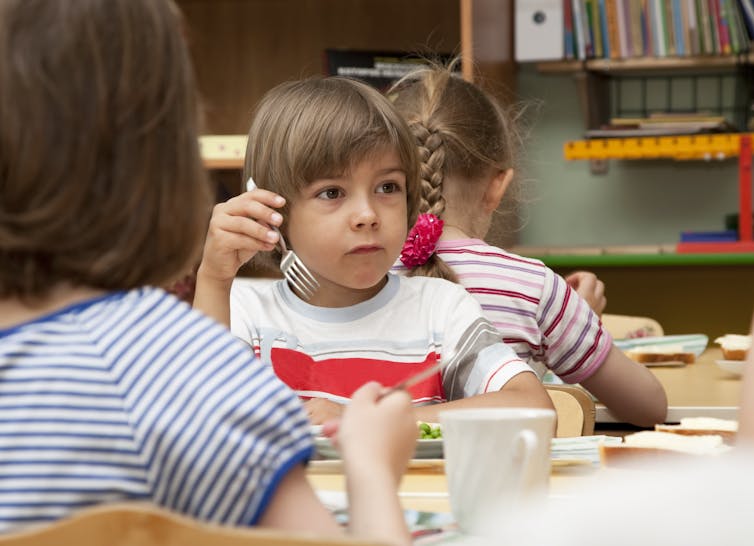 Free school meals can help families.
Kuznetsov Alexey/Shutterstock
Free school meals can help families.
Kuznetsov Alexey/Shutterstock
Another challenge families have is the high cost of childcare. This reduces the number of women who return to work after having children, limiting family income. While an increase in government-funded hours of childcare has reduced costs in England for children aged under two, for those parents of three- and four-year-olds who already received a subsidy costs have gone up, as they in Wales and Scotland.
Testimonies from children collected by the Children’s Commissioner for England lay the problem of child poverty bare. A 14-year-old girl explained how she worried her family wouldn’t have enough to eat. “We do try as much as possible to save up what we have,” she said.
“Every time I got [food packages] the food was always out of date and mouldy,” said an 11-year-old boy. “I know I’m poor but I’m not going to eat mouldy food.”
What works
The government’s recent budget included the significant step of lifting the two-child cap on benefits, which limited the means-tested support that families could receive from the state to the first two children in a household. The removal of this limit will lift around 500,000 children out of poverty.
The government has also pledged to reduce the time families live in temporary housing such as bed and breakfasts. From 2026, free school meals will be available to all children in families on universal credit. This is progress – but children will still slip through the cracks.
It’s estimated that a third of the children in the deepest poverty are from migrant families, who have no access to state benefits.
Read more: To truly tackle child poverty, the UK needs to look again at migration policy
One strategy that we can see is working is the provision of free school meals for all children in London. Three in five (60%) parents surveyed said they were able to spend more money on food as a result of free school meals, while 84% said that the provision of school lunches had helped their household finances.
Further action on child poverty requires investment in community support services, such as community kitchens and community support centres, which address the root causes poverty. Communities and children should be at the centre of future policies and plans.
- Free school meals
- Child poverty
- Give me perspective
- two-child limit
Events
Jobs
-
 Senior Lecturer, Autism & Neurodivergent Studies/Special Education
-
Manager, Graduations, Fees and Scholarships
-
Talent Integrity and Contracts Advisor
-
Respect and Safety Project Manager
-
Associate Dean, School of Information Technology and Creative Computing | SAE University College
 Senior Lecturer, Autism & Neurodivergent Studies/Special Education
 Manager, Graduations, Fees and Scholarships
 Talent Integrity and Contracts Advisor
 Respect and Safety Project Manager
 Associate Dean, School of Information Technology and Creative Computing | SAE University College
- Editorial Policies
- Community standards
- Republishing guidelines
- Analytics
- Our feeds
- Get newsletter
- Who we are
- Our charter
- Our team
- Partners and funders
- Resource for media
- Contact us
-
-
-
-
Copyright © 2010–2025, The Conversation
