- Home
Edition
Africa Australia Brasil Canada Canada (français) España Europe France Global Indonesia New Zealand United Kingdom United States Edition:
Global
Edition:
Global
- Africa
- Australia
- Brasil
- Canada
- Canada (français)
- España
- Europe
- France
- Indonesia
- New Zealand
- United Kingdom
- United States
Academic rigour, journalistic flair
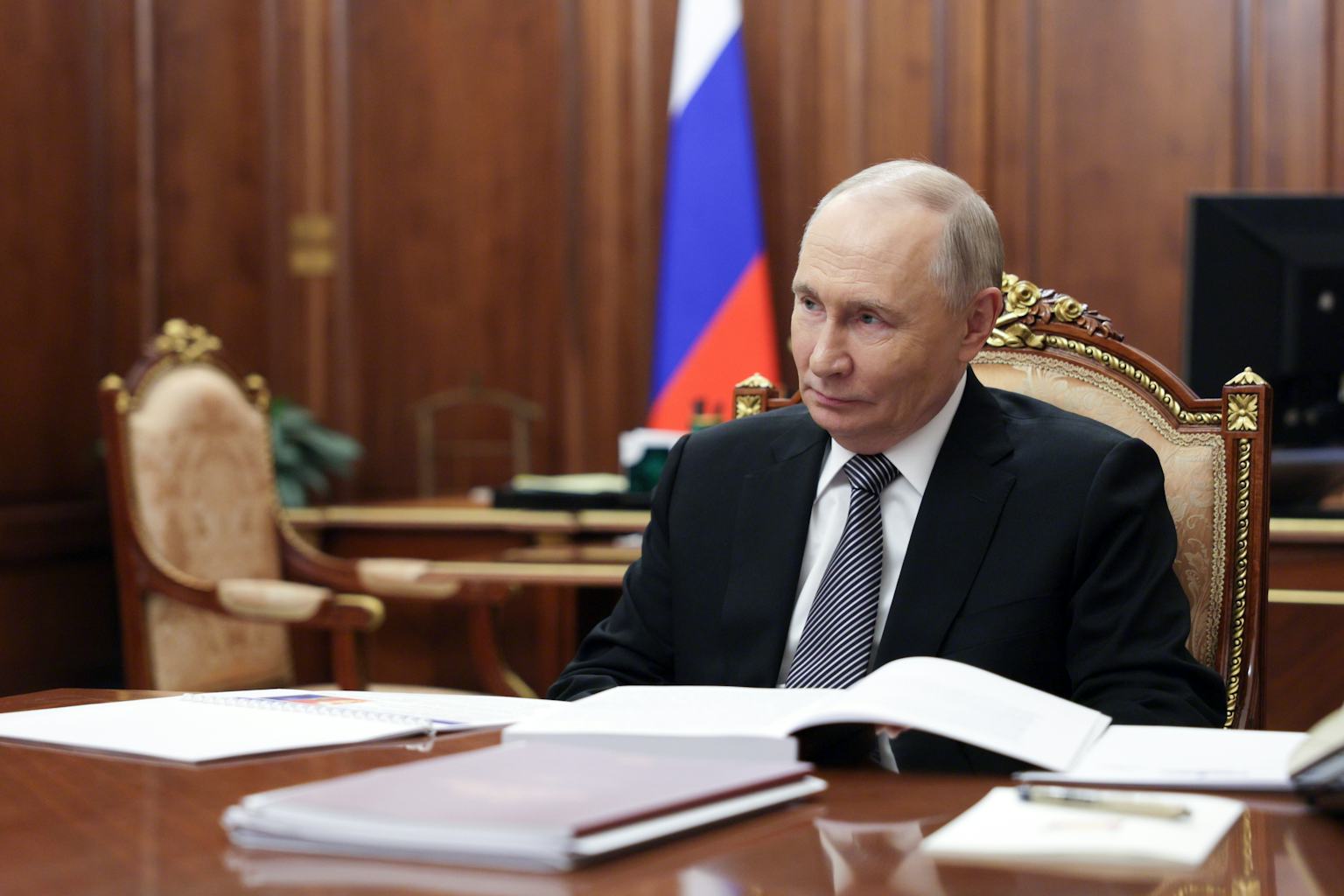 The Russian president, Vladimir Putin, attends a meeting at the Kremlin in Moscow on December 9.
Gavriil Grigorov / Kremlin Pool / EPA
Russia’s war economy is not collapsing, but neither is it stable
Published: December 17, 2025 5.34pm GMT
Yerzhan Tokbolat, Queen's University Belfast
The Russian president, Vladimir Putin, attends a meeting at the Kremlin in Moscow on December 9.
Gavriil Grigorov / Kremlin Pool / EPA
Russia’s war economy is not collapsing, but neither is it stable
Published: December 17, 2025 5.34pm GMT
Yerzhan Tokbolat, Queen's University Belfast
Author
-
 Yerzhan Tokbolat
Lecturer in Finance, Queen's University Belfast
Disclosure statement
Yerzhan Tokbolat does not work for, consult, own shares in or receive funding from any company or organisation that would benefit from this article, and has disclosed no relevant affiliations beyond their academic appointment.
Partners

Queen's University Belfast provides funding as a founding partner of The Conversation UK.
View all partners
DOI
https://doi.org/10.64628/AB.j475x6f43
https://theconversation.com/russias-war-economy-is-not-collapsing-but-neither-is-it-stable-271700 https://theconversation.com/russias-war-economy-is-not-collapsing-but-neither-is-it-stable-271700 Link copied Share articleShare article
Copy link Email Bluesky Facebook WhatsApp Messenger LinkedIn X (Twitter)Print article
Russia’s wartime economy is getting weaker as the war in Ukraine approaches its fourth anniversary, according to a recent report by PeaceRep, a research group led by the University of Edinburgh. The report, Against the Clock? Why Russia’s War Economy is Running Out of Time, finds that Russia is being forced to spend aggressively on the war, while its earning abilities have dropped significantly.
The funding source used to finance much of this spending, Russia’s sovereign wealth fund, also looks to be dwindling. According to the report, around 76% of the fund’s US$148 billion (£110 billion) pre-war liquid reserves was spent within the first three years of the war.
In an article in May, I argued that Russian leader Vladimir Putin could afford a drawn-out war because he had spent more than 20 years preparing for it. Under Putin’s leadership Russia has consistently posted budget surpluses, amassed foreign currency reserves and reduced its reliance on western debt.
The question now is how far can that preparation carry the Russian economy? For the moment, it appears Russia can still sustain the war. But it can do so only by drawing heavily on earlier buffers, such as foreign reserves and the sovereign wealth fund, while diverting an ever-growing share of national resources towards the military.
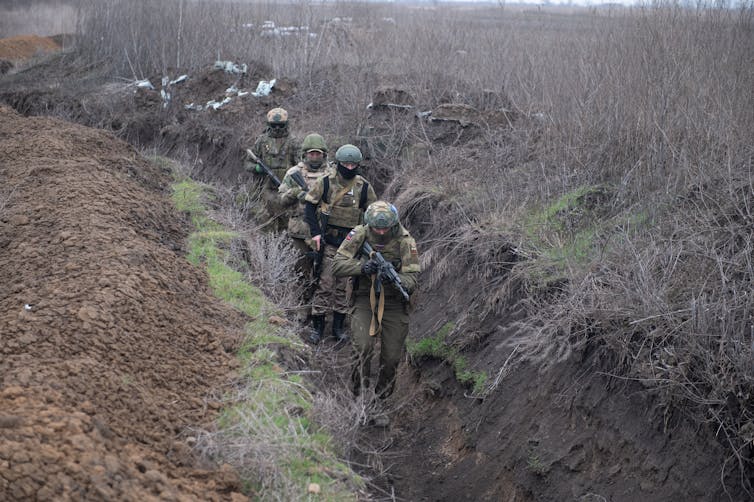 Russian servicemen on the frontlines in eastern Ukraine.
Sergey Nikonov / Shutterstock
Russian servicemen on the frontlines in eastern Ukraine.
Sergey Nikonov / Shutterstock
The strain on Russia’s economy is being compounded by mounting external pressures. The EU, which is currently the largest buyer of Russian liquefied natural gas (LNG) and pipeline gas, announced in early December that it would end its imports of Russian LNG in 2026. Imports of pipeline gas will end the following year.
But Russia’s revenue streams have remained relatively resilient throughout the war. Russia has diversified its exports of crude oil, with China now accounting for around 47%, India about 38% and Turkey roughly 6%. These revenue flows, together with earlier economic preparation, have helped sustain the three core areas that shape any wartime economy: industrial output, fiscal capacity and social resilience.
According to 2024 analysis by the Centre for Economic Policy Research, war-related output in Russia surged by about 60% in the early years of the conflict. That expansion still underpins Russia’s industrial base today. War-related industries have accounted for almost all of manufacturing growth since the invasion.
Energy revenues also continue to bolster the federal budget, though the government is relying increasingly on domestic borrowing and reserve drawdowns to fund deficits. And on the household side, higher wages in military-linked sectors and targeted government payments to the families of mobilised soldiers have helped soften the impact of inflation. Income from mobilisation has even lifted household savings, particularly in poorer regions of Russia.
Yet this appearance of stability reflects an economy being stretched rather than strengthened. Defence-related activity now dominates manufacturing, drawing labour and capital away from civilian sectors. Civilian industries are losing workers, machinery and investment, which is deepening structural stagnation and will make future economic recovery more difficult. What looks like resilience is, in practice, a system operating under growing strain.
Russia’s unsustainable economy
The central question now is how long can Russia’s remaining buffers support its militarised economy? Labour shortages have become structural rather than temporary, and inflationary pressures have persisted even amid weakening growth. Demographic pressures add to this squeeze, with mobilisation, emigration and long-term population decline shrinking the workforce available to both industry and the military.
Technological limits are tightening too. Export controls have cut Russia off from many advanced components, increasing reliance on parallel imports and domestic substitutes that are often more expensive or less reliable. This is slowing production and constraining the sophistication of new military systems.
A notable shift is also emerging in how the war is financed. With industry and labour close to capacity, and the EU phasing out Russian gas, the government can no longer rely on economic expansion or strong energy revenues to support the budget.
The new three-year budget, submitted to parliament in late September, raises VAT and expands the tax burden on small businesses. This will pass more of the cost of the war on to households and firms, a model that will only remain viable while the public tolerates higher taxes and gradually declining living standards. That makes its long-term sustainability uncertain.
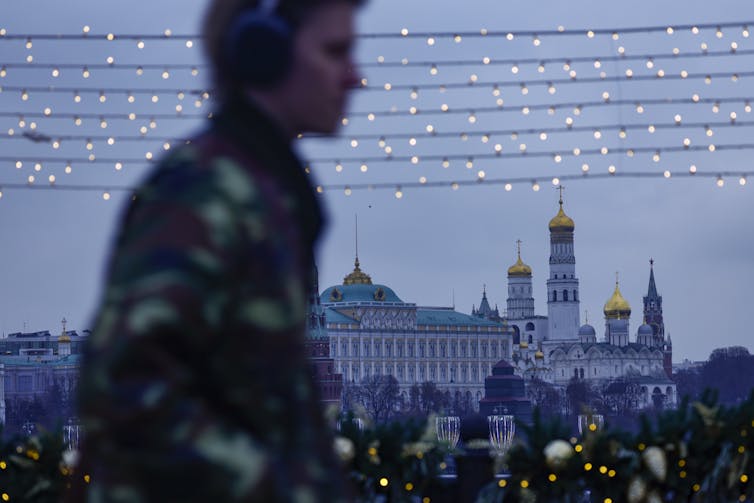 A man walks in front of the Kremlin in Moscow on December 8.
Sergei Ilnitsky / EPA
A man walks in front of the Kremlin in Moscow on December 8.
Sergei Ilnitsky / EPA
How long Russia can continue fighting will also depend on forces beyond its borders. China and India are essential buyers of Russian oil, slowing the point at which fiscal pressures fully tighten. Meanwhile, tighter US and EU sanctions are constraining Russia’s access to advanced technology and complicating the logistics of foreign trade.
Geopolitics adds another layer of uncertainty. The latest US-drafted peace proposal for Ukraine echoes several longstanding Russian demands, while a major corruption scandal in Kyiv has weakened Ukraine’s political position at a sensitive moment.
These developments do not remove Russia’s economic vulnerabilities. But they do shape the environment in which Moscow navigates them, lowering the political cost of continuing the war even as economic pressures rise.
Russia’s war economy is not collapsing, but neither is it stable. It survives by pushing strain into the future – into labour markets, public finances and the everyday lives of Russian households.
The key question is how long the system can keep absorbing these pressures before they begin to reinforce one another. In that sense, Russia’s wartime economy still has time – but it is increasingly time borrowed from the future.
- Russia
- Vladimir Putin
- Ukraine
- Russian economy
- Moscow
- Give me perspective
- Russian-Ukraine war
Events
Jobs
-
 Senior Lecturer, Autism & Neurodivergent Studies/Special Education
-
Manager, Graduations, Fees and Scholarships
-
Talent Integrity and Contracts Advisor
-
Respect and Safety Project Manager
-
Associate Dean, School of Information Technology and Creative Computing | SAE University College
 Senior Lecturer, Autism & Neurodivergent Studies/Special Education
 Manager, Graduations, Fees and Scholarships
 Talent Integrity and Contracts Advisor
 Respect and Safety Project Manager
 Associate Dean, School of Information Technology and Creative Computing | SAE University College
- Editorial Policies
- Community standards
- Republishing guidelines
- Analytics
- Our feeds
- Get newsletter
- Who we are
- Our charter
- Our team
- Partners and funders
- Resource for media
- Contact us
-
-
-
-
Copyright © 2010–2025, The Conversation
