
- Home
Edition
Africa Australia Brasil Canada Canada (français) España Europe France Global Indonesia New Zealand United Kingdom United States Skip to content Edition:
Global
Edition:
Global
- Africa
- Australia
- Brasil
- Canada
- Canada (français)
- España
- Europe
- France
- Indonesia
- New Zealand
- United Kingdom
- United States
Academic rigour, journalistic flair
 Conservative Leader Pierre Poilievre delivers his keynote address at the party’s national convention in Calgary, on Jan. 30, 2026.
THE CANADIAN PRESS/Larry MacDougal
Pierre Poilievre: The most successful unsuccessful leader in Canadian politics?
Published: January 29, 2026 9.57pm GMT
•Updated: January 31, 2026 1.57pm GMT
Stewart Prest, University of British Columbia
Conservative Leader Pierre Poilievre delivers his keynote address at the party’s national convention in Calgary, on Jan. 30, 2026.
THE CANADIAN PRESS/Larry MacDougal
Pierre Poilievre: The most successful unsuccessful leader in Canadian politics?
Published: January 29, 2026 9.57pm GMT
•Updated: January 31, 2026 1.57pm GMT
Stewart Prest, University of British Columbia
Author
-
 Stewart Prest
Lecturer, Political Science, University of British Columbia
Disclosure statement
Stewart Prest does not work for, consult, own shares in or receive funding from any company or organisation that would benefit from this article, and has disclosed no relevant affiliations beyond their academic appointment.
Partners

University of British Columbia provides funding as a founding partner of The Conversation CA.
University of British Columbia provides funding as a member of The Conversation CA-FR.
View all partners
DOI
https://doi.org/10.64628/AAM.5wct3nktf
https://theconversation.com/pierre-poilievre-the-most-successful-unsuccessful-leader-in-canadian-politics-274358 https://theconversation.com/pierre-poilievre-the-most-successful-unsuccessful-leader-in-canadian-politics-274358 Link copied Share articleShare article
Copy link Email Bluesky Facebook WhatsApp Messenger LinkedIn X (Twitter)Print article
Nine months after falling definitively short in the 2025 federal election, Pierre Poilievre faced a mandatory leadership review at this weekend’s Conservative Party convention — and passed it with flying colours.
Almost 90 per cent of Conservative Party members voted for him to remain as leader.
That support extends to the broader voting coalition Poilievre has assembled, which continues to stand behind his leadership for the most part. Recent polling suggests that more than three quarters of Conservative voters view him as doing an “excellent” job.
The problem for Poilievre and the party, however, is that among those who did not vote Conservative, the view is starkly different. In that same recent Abacus poll, 62 per cent of non-Conservative voters reported he’s doing a “poor” or “very poor” job.
In a sense, Poilievre is the most successful unsuccessful leader in Canadian politics.
The Justin Trudeau problem
If you count by share of the vote, Poilievre led the party to its best showing in nearly 40 years in last year’s federal election. Brian Mulroney was the last leader of a Conservative party to crack 40 per cent of the vote share across the country. He also got the party to its best share of seats since Stephen Harper’s lone majority victory in 2011.
Poilievre managed to pull together, and even expand, the coalition of Conservative voters, appealing in particular to younger male voters, and was making inroads with labour voters — at least until Donald Trump showed up for his second term as American president.
Thanks largely due to Trump’s threats to make Canada a 51st state, Liberals performed even better in the election. Defying the odds, newly minted Prime Minister Mark Carney led the Liberals back from what seemed like certain defeat, assisted by the emergence of a far more more belligerent United States following Trump’s return.
Read more: Canada's Conservatives, with an assist from Donald Trump, are down — but they're far from out
The Liberals bested the Conservatives in vote share and seat share, cementing Carney’s leadership of the country.
Poilievre’s approach to politics as opposition leader almost certainly influenced the Liberal rebound after Justin Trudeau stepped down — and when an electoral landslide seemed all but assured for the Conservatives.
Because Canadians considered Trudeau a problem, Poilievre’s take-no-prisoners approach paid significant dividends. The Conservatives led the Liberals by an increasingly comfortable margin throughout 2024. Language about the country being broken didn’t seem out of place to those tired of the status quo.
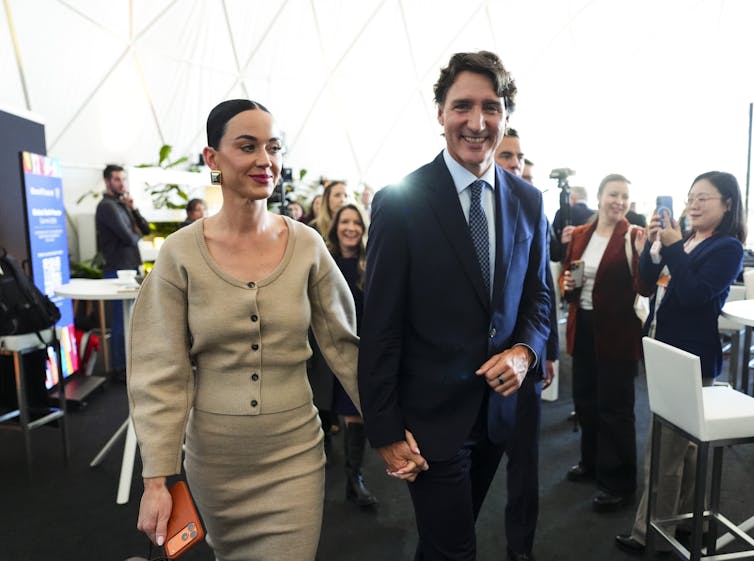 Former prime minister Justin Trudeau holds hands with pop star Katy Perry as they leave an event during the World Economic Forum in Davos, Switzerland, on Jan. 20, 2026.
THE CANADIAN PRESS/Sean Kilpatrick
Former prime minister Justin Trudeau holds hands with pop star Katy Perry as they leave an event during the World Economic Forum in Davos, Switzerland, on Jan. 20, 2026.
THE CANADIAN PRESS/Sean Kilpatrick
The Donald Trump impact
As soon as Trump made himself the problem, however, most Canadians looked for a much more fulsome response than Poilievre was able to offer. Rather than a leader focused on criticizing Canada, the majority of Canadians above all wanted one who promised to stand up against the American threat.
Similarities between Poilievre and Trump — sometimes rhetorical, other times substantive and sometimes both — deepened the suspicion.
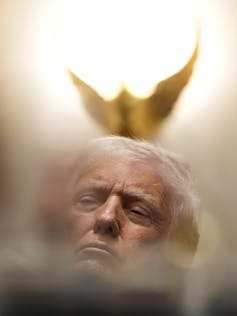 U.S. President Donald Trump listens during a cabinet meeting at the White House in December 2025 in Washington, D.C.
(AP Photo/Julia Demaree Nikhinson)
U.S. President Donald Trump listens during a cabinet meeting at the White House in December 2025 in Washington, D.C.
(AP Photo/Julia Demaree Nikhinson)
This divisiveness has continued to plague the party in the months since the 2025 election. One Conservative MP has decided to resign and two others have actually crossed the floor to join the Liberals, bringing the governing party within a hair’s breadth of a majority.
Nova Scotia MP Chris d'Entremont cited Poilievre’s leadership style specifically in explaining his decision to become a Liberal, suggesting the Conservative leader was too negative at a time when the country needed solutions-oriented politics.
This remains the quandary for the Conservative leader and the party: everything Poilievre does to secure the support of the more populist wing of the conservative movement in Canada tends to alienate the rest of the country, while any move to the centre risks condemnation from those further to the right.
Poilievre has won over core Conservatives and alienated the rest of the country, including that crucial share of voters necessary to push the Conservatives over the top.
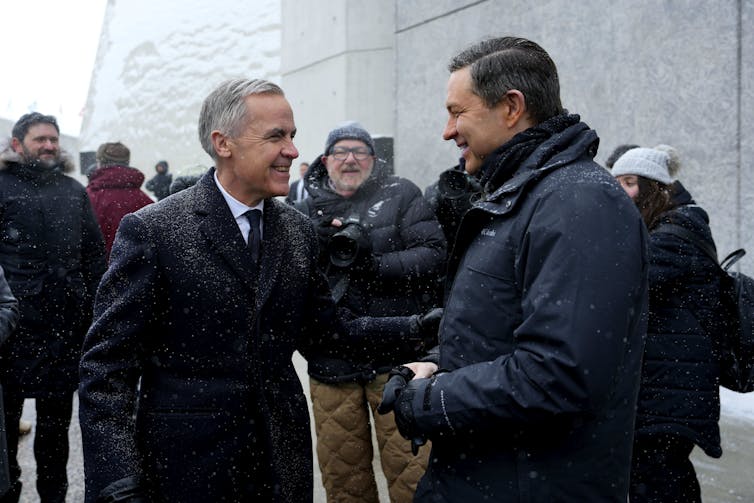 Prime Minister Mark Carney greets Conservative Leader Pierre Poilievre as they arrive at an International Holocaust Remembrance Day event at the National Holocaust Memorial in Ottawa, on Jan. 27, 2026.
THE CANADIAN PRESS/Justin Tang
Prime Minister Mark Carney greets Conservative Leader Pierre Poilievre as they arrive at an International Holocaust Remembrance Day event at the National Holocaust Memorial in Ottawa, on Jan. 27, 2026.
THE CANADIAN PRESS/Justin Tang
Repelling more than he attracts
There is, to be sure, a path to victory still available to the Conservatives. A resurgent NDP, or some other wobble in Liberal fortunes, could be enough to put the Conservatives over the top next federal election.
They cannot count on such luck, however. Faced with the generational event that is the second Trump presidency, many Canadians are viewing the current Canada-U.S. tensions as an “us/them” existential battle, with other issues pushed into the background.
This week’s premier’s meeting in New Brunswick, for example, focused heavily on national unity. So too did Carney’s meeting with premiers in Ottawa.
This seems likely to persist so long as the U.S. poses a threat to Canadian security and prosperity. And as long as Poilievre presents himself as being sympathetic to Trump’s populist project, Canadians not already in the Conservative column will look to keep him out of the Prime Minister’s Office.
The strong endorsement of Poilievre’s leadership this weekend therefore means a continuation of the status quo: a country that has come together on a question of existential importance, but an opposition leader who divides, repelling more than he attracts.
- Mark Carney
- Donald Trump
- Justin Trudeau
- Pierre Poilievre
- Canada-US relationship
- Donald Trump's threats against Canada
Events
Jobs
-
 RMIT EOI for Aboriginal & Torres Strait Islander peoples
-
University Librarian
-
Video Commissioning Editor
-
Postdoctoral Research Fellow or Research Fellow
-
Lecturer / Sr. Lecturer / A/Professor in Statistics for Omics
 RMIT EOI for Aboriginal & Torres Strait Islander peoples
 University Librarian
 Video Commissioning Editor
 Postdoctoral Research Fellow or Research Fellow
 Lecturer / Sr. Lecturer / A/Professor in Statistics for Omics
- Editorial Policies
- Community standards
- Republishing guidelines
- Analytics
- Our feeds
- Get newsletter
- Who we are
- Our charter
- Our team
- Partners and funders
- Resource for media
- Contact us
-
-
-
-
Copyright © 2010–2026, The Conversation