
- Home
Edition
Africa Australia Brasil Canada Canada (français) España Europe France Global Indonesia New Zealand United Kingdom United States Skip to content Edition:
Global
Edition:
Global
- Africa
- Australia
- Brasil
- Canada
- Canada (français)
- España
- Europe
- France
- Indonesia
- New Zealand
- United Kingdom
- United States
Academic rigour, journalistic flair
Trump’s clash with the gun lobby
Published: January 29, 2026 8.12pm GMT
Jonathan Este, The Conversation
Author
-
 Jonathan Este
Senior International Affairs Editor, Associate Editor
Partners
View all partners
DOI
https://doi.org/10.64628/AB.n7qy4s34q
 A majority of American citizens are against the way the Trump administration is enforcing its immigration policy.
AP Photo/Jose Luis Magana
https://theconversation.com/trumps-clash-with-the-gun-lobby-274675
https://theconversation.com/trumps-clash-with-the-gun-lobby-274675
Link copied
Share article
A majority of American citizens are against the way the Trump administration is enforcing its immigration policy.
AP Photo/Jose Luis Magana
https://theconversation.com/trumps-clash-with-the-gun-lobby-274675
https://theconversation.com/trumps-clash-with-the-gun-lobby-274675
Link copied
Share article
Share article
Copy link Email Bluesky Facebook WhatsApp Messenger LinkedIn X (Twitter)Print article
This article was first published in The Conversation UK’s World Affairs Briefing email. Sign up to receive weekly analysis of the latest developments in international relations, direct to your inbox.
The US government’s reaction to the killing of Alex Pretti last weekend – and of Renée Good a fortnight earlier – was a grim reminder of George Orwell’s dystopian masterpiece Nineteen Eighty-Four, in which: “The Party told you to reject the evidence of your eyes and ears. It was their final, most essential command.”
In similar fashion, senior members of the Trump administration asked the American people to reject freely available video evidence of the two killings. They claimed that Pretti, a nurse at a local veterans’ hospital, was a “domestic terrorist”, that he was “brandishing a handgun”, and was “an assassin” who “tried to murder federal agents”. Good, a mother of three, supposedly “viciously ran over the ICE officer” who then put three bullets in her head.
Given that video evidence flatly contradicts those statements, this could yet prove a serious overreach on the part of Donald Trump and his lieutenants. Already border patrol commander Greg Bovino, who was in charge of ICE operations in Minneapolis, has been removed. And there’s speculation that Kristi Noem, US secretary of homeland security, is under serious pressure.
How BBC Verify analysed available video footage of Alex Pretti’s death.One of the more objectionable claims from some of the people looking to blame the victims, writes Andrew Gawthorpe, was the claim made by several Trump officials – and the president himself – that by carrying a gun, Pretti had been asking for trouble.
As you might expect, this drew a sharp reaction from both the National Rifle Association and the Gun Owners of America. These two organisations, who are among Trump’s staunchest backers, reminded the administration of the second amendment right to bear arms, even to a protest – something which also brings in the first amendment right to free expression.
Gawthorpe, an expert in US history and politics at Leiden University, points to the dramatic irony at play here. The express intention of the second amendment was to allow American citizens to arm themselves against a tyrannical government. He concludes: “While some gun rights advocates may have been willing to keep quiet while federal agents were trampling on the rights of migrants and brown-skinned citizens, the murder of Pretti is a bridge too far.”
Read more: Shooting of Alex Pretti in Minneapolis has put America's gun lobby at odds with the White House
Meanwhile Mark Shanahan, a professor of political engagement at the University of Surrey, addresses some important points raised by Pretti’s killing. What are federal agents doing on the streets of Minneapolis in the first place, what will the episode mean for Trump’s popularity, and what can be done to prevent further violence?
When it comes to the last question, he argues that the removal of one of the key ICE personnel from the city is a start. Proper congressional scrutiny of ICE’s funding, which is set to sharply increase again this year, would also appear appropriate.
Read more: Why the shooting of Alex Pretti in Minneapolis is so significant – expert Q&A
George Lewis, a professor of American history at the University of Leicester, reminds us that Americans have fought back against authoritarianism before. From the 1930s to the 1970s, the House Un-American Activities Committee (Huac) terrorised liberal Americans in its bid to root out communism and (vaguely defined) “un-American” activities such as campaigning for civil rights.
However, a concerted campaign by liberal lawmakers including Jimmy Roosevelt inside Congress, as well as legions of well-organised activists, managed to consign Huac to history’s dustbin in 1975.
Read more: Americans have fought back against authoritarianism at home before
Ukraine: diplomatic stalemate
We’re still waiting to hear whether Vladimir Putin plans to sign up to Donald Trump’s “Board of Peace”. But the signs aren’t all that good. The Ukrainian president, Volodymyr Zelensky, was making some positive noises earlier this week about the prospect of securing security guarantees from Washington. This followed the latest round of talks in Abu Dhabi – at which, for the first time, representatives of Russia, Ukraine and the US came together to talk about ways to end the war.
But almost as soon as Zelensky had revealed his optimism that a deal might be possible, American sources indicated that in return for US security guarantees, Ukraine would have to accept the loss of the parts of the Donbas region it still occupies. This is a non-starter, as Ukraine considers the territory strategically vital.
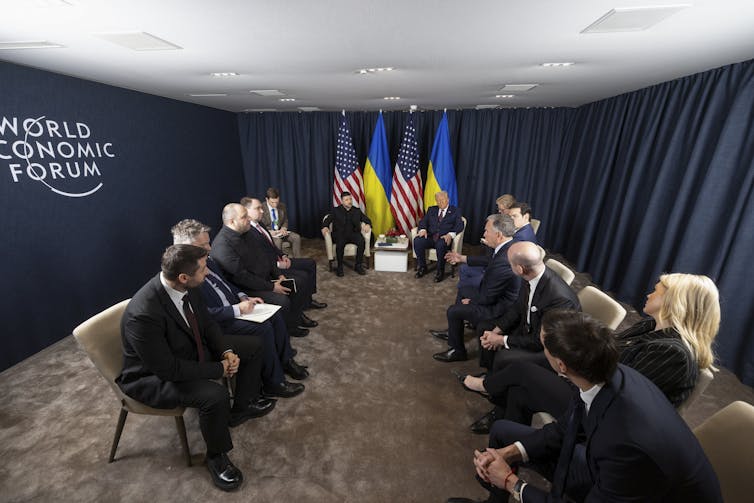 Volodymyr Zelensky and Donald Trump discuss security guarantees at Davos.
EPA/Ukrainian presidential press service handout.
Volodymyr Zelensky and Donald Trump discuss security guarantees at Davos.
EPA/Ukrainian presidential press service handout.
As Stefan Wolff points out, we’ve been here before. Zelensky can’t accept this condition – and even if he does, Putin won’t accept US guarantees. Trump, meanwhile, will more than likely blame the Ukrainian president for the lack of a deal.
Read more: Ukraine: Zelensky upbeat on US deal – but Davos showed the US president to be an unreliable ally
After 12 months of Trump’s second term, the unreliability of the US as an ally for Europe and the rest of Nato is becoming ever more evident. The US president’s Board of Peace appears designed to undermine the United Nations, while his negative rhetoric about US military allies, including the UK, appeared calculated to cause maximum offence (even if Trump later walked back some of his more controversial statements).
David Dunn, a specialist in the US and international security at the University of Birmingham, believes that while Trump may see the world in terms of great power competition, the recent World Economic Forum in Davos, Switzerland revealed a growing determination on the part of “medium-sized powers” to face up to this new reality – and begin building a new system that does not rely on Washington to make the running.
Read more: US foreign policy has taken a radical turn in Trump's first year back in office
War in Iran?
After calling on the people of Iran to keep protesting a fortnight ago, promising that “help is on its way”, the US president has ordered a “beautiful armada” into the Gulf, from where it can put pressure on Iran. In fact, the deployment of the aircraft carrier USS Abraham Lincoln and its strike group appears designed to get the Islamic Republic to dismantle its nuclear programme.
But the likelihood of this developing into full-scale conflict between the US and Iran is very slim, writes Bamo Nouri. He thinks it doubtful that US action can easily dislodge the regime. Despite the widespread recent protests, the Islamic Republic remains firmly embedded and has spent decades preparing for a possible war with the US.
Nouri, a journalist and international relations expert at City St George’s, University of London, believes that any conflict between the US and Iran would almost certainly destabilise the entire Middle East – and would be highly likely to spread. It’s the last thing that America’s allies in the region want, he concludes.
Read more: Why it would be a big mistake for the US to go to war with Iran

Sign up to receive our weekly World Affairs Briefing newsletter from The Conversation UK. Every Thursday we’ll bring you expert analysis of the big stories in international relations.
- Vladimir Putin
- Donald Trump
- Volodymyr Zelensky
- US-Iran
- Minneapolis
- Ukraine invasion 2022
- Trump 2.0
- Minneapolis ICE shooting
Events
Jobs
-
 RMIT EOI for Aboriginal & Torres Strait Islander peoples
-
University Librarian
-
Video Commissioning Editor
-
Postdoctoral Research Fellow or Research Fellow
-
Lecturer / Sr. Lecturer / A/Professor in Statistics for Omics
 RMIT EOI for Aboriginal & Torres Strait Islander peoples
 University Librarian
 Video Commissioning Editor
 Postdoctoral Research Fellow or Research Fellow
 Lecturer / Sr. Lecturer / A/Professor in Statistics for Omics
- Editorial Policies
- Community standards
- Republishing guidelines
- Analytics
- Our feeds
- Get newsletter
- Who we are
- Our charter
- Our team
- Partners and funders
- Resource for media
- Contact us
-
-
-
-
Copyright © 2010–2026, The Conversation