
- Home
Edition
Africa Australia Brasil Canada Canada (français) España Europe France Global Indonesia New Zealand United Kingdom United States Skip to content Edition:
Global
Edition:
Global
- Africa
- Australia
- Brasil
- Canada
- Canada (français)
- España
- Europe
- France
- Indonesia
- New Zealand
- United Kingdom
- United States
Academic rigour, journalistic flair
 A critically endangered hammerhead shark caught as bycatch in a gillnet.
Francesca Page, Author provided (no reuse)
New limits on global trade of sharks won’t be enough to save them from overfishing – new research
Published: January 30, 2026 1.01pm GMT
Hollie Booth, University of Oxford, Bangor University
A critically endangered hammerhead shark caught as bycatch in a gillnet.
Francesca Page, Author provided (no reuse)
New limits on global trade of sharks won’t be enough to save them from overfishing – new research
Published: January 30, 2026 1.01pm GMT
Hollie Booth, University of Oxford, Bangor University
Author
-
 Hollie Booth
Senior Research Fellow, Conservation Science, University of Oxford; Bangor University
Disclosure statement
Hollie Booth is the Co-Founder and Director of Yayasan Kebersamaan Untuk Lautan, a marine conservation non-profit in Indonesia.
Partners

University of Oxford and Bangor University provide funding as members of The Conversation UK.
View all partners
DOI
https://doi.org/10.64628/AB.vf5vngd4x
https://theconversation.com/new-limits-on-global-trade-of-sharks-wont-be-enough-to-save-them-from-overfishing-new-research-273256 https://theconversation.com/new-limits-on-global-trade-of-sharks-wont-be-enough-to-save-them-from-overfishing-new-research-273256 Link copied Share articleShare article
Copy link Email Bluesky Facebook WhatsApp Messenger LinkedIn X (Twitter)Print article
More than one-third of sharks and rays are now threatened with extinction, making them among the most imperilled vertebrates on Earth. Why? Overfishing, both as targeted catches for their valuable fins, meat, gills and liver oil, and as bycatch in nets and lines set for other fish.
In late 2025, governments took sweeping action for sharks and rays. At a global conference on wildlife trade in Uzbekistan more than 70 shark and ray species received new or stronger international trade limits.
Whale shark, oceanic whitetip shark, wedgefish, devil rays and gulper sharks were among those subject to stricter regulations. This is a major political milestone for shark conservation.
But here’s the uncomfortable truth: as I outline in my new research paper published in the journal Nature Ecology and Evolution, trade regulation alone won’t save sharks.
Cites, the convention on international trade in endangered species of wild fauna and flora, is the main global agreement regulating international wildlife trade, seeking to ensure the survival of the 41,000 species covered by the convention.
Read more: The world wildlife trade regulator is 50 – here's what has worked and what needs to change
Countries can only export most of the more than 1,000 shark and ray species covered by Cites regulations if they demonstrate trade is sustainable. A handful of highly threatened species (including sawfishes, manta and devil rays, whale shark, oceanic whitetip shark) are afforded the highest protection, where international trade is permitted only under exceptional circumstances.
In theory, these regulations can reduce fishing pressure. In practice, the pathway from paperwork to population recovery is far from guaranteed.
 Young hammerheads for sale in local markets, to be eaten in shark curry.
Hollie Booth, Author provided (no reuse)
Young hammerheads for sale in local markets, to be eaten in shark curry.
Hollie Booth, Author provided (no reuse)
Promise and pitfalls
International trade is only one driver of shark overfishing. Shark and ray fishing mortality is also a byproduct of wild-caught fish. And, in many small-scale fisheries, sharks and rays are valuable secondary catch – meaning they are not the main target catch, but they still have value to fishers because they are sold in domestic markets or eaten locally.
These local drivers sustain fishing mortality, which means lots of sharks and rays get killed regardless of what happens to international trade.
Some shark fishing isn’t even driven by demand. In many coastal communities, production is supply driven: shaped mainly by the need to generate income and survive.
In Indonesia, when I’ve asked fishers what they’d do if shark prices fell, some say they’ll fish harder, not less, to maintain their income. In such contexts, Cites listings alone are unlikely to reduce fishing pressure unless trade regulations drive efforts to address local causes of overfishing.
Cites is also implemented through each country’s own policies and domestic management measures. Those can range from exemplary – with meaningful, well-implemented trade management that helps wild populations recover (such as the saiga antelope in Kazakhstan) to performative – where regulations exist on paper but are never implemented in practice (this includes, arguably, protection for some sharks, based on recent global trade analyses).
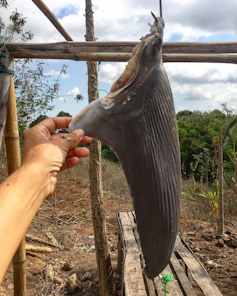 A shark fin drying in the sun. Some consumers have explicit preferences for higher priced and rare shark-fins.
Hollie Booth, Author provided (no reuse)
A shark fin drying in the sun. Some consumers have explicit preferences for higher priced and rare shark-fins.
Hollie Booth, Author provided (no reuse)
Even trade restrictions implemented with good intentions can backfire. For example, when supply is restricted but demand stays strong, prices rise – potentially incentivising more fishing and black markets.
This dynamic has played out with pangolins and ivory and cannot be ignored for sharks and rays, especially due to the “the snob effect” – when demand for a product increases as it becomes rarer or more expensive. When people consume shark products to display their status, scarcity can make them more attractive – meaning that restrictions on shark fishing might accidentally drive up demand rather than reduce it.
There’s also displacement to consider. When Indonesia protected manta rays, some fishers shifted to catching other unprotected ray species instead. Restrictions in one part of the market can redistribute pressure rather than reduce it.
From paperwork to positive outcomes
Three broad scenarios now lie ahead for sharks and rays.
In the best case, Cites catalyses integrated reforms across trade chains and the entire seafood sector. Supply countries establish sustainable catch limits to manage bycatch and targeted fisheries in small-scale and commercial contexts. Limits are implemented through effective compliance management including fair support for small-scale fishers already on the margins.
On the demand side, targeted demand management for shark products and other seafood with embedded negative impacts weakens the market signals that makes overfishing profitable in the first place. Overfishing halts and populations begin to recover. Evidence from mammals suggests this pathway is possible – but only if Cites triggers a range of global-to-local management measures.
In a business-as-usual scenario, the new listings deliver little. Countries adopt policies on paper while fishing continues unabated. Trade continues legally, in domestic markets or through new international bureaucracies, or moves illegally, through black markets and laundering. Current evidence on global shark trade flows suggests this is the direction of travel, though these new listings may shift the needle.
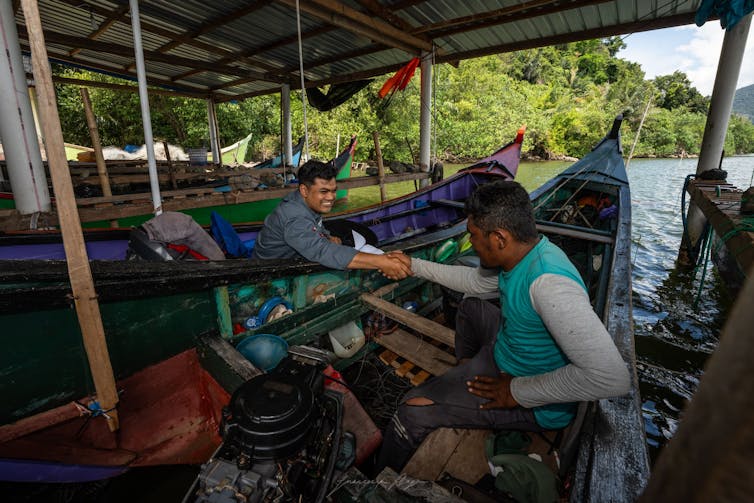 A fisher shakes hands with a researcher in Aceh Province, Indonesia, as part of a community-based shark conservation project by Yayasan Kebersamaan Untuk Lautan.
Francesca Page, Author provided (no reuse)
A fisher shakes hands with a researcher in Aceh Province, Indonesia, as part of a community-based shark conservation project by Yayasan Kebersamaan Untuk Lautan.
Francesca Page, Author provided (no reuse)
In the worst case, well-intended restrictions backfire. Prices spike, black markets expand, and fishers – squeezed economically – fish harder and riskier. Policy inadvertently accelerates decline.
Which future unfolds depends on what happens next. New Cites listings represent an opportunity for transformative change. But only if they are seen as a means to an end – one which catalyses broader reforms, from fisheries through to consumption, focused on limiting fishing mortality – rather than a standalone measure.
If the goal is a more sustainable future for both people and nature, then success must be measured in both the abundance and diversity of species and the wellbeing of people, not in the number of new policies. New trade regulations got the headlines. The harder, messier work of making them count starts now.

Don’t have time to read about climate change as much as you’d like? Get a weekly roundup in your inbox instead. Every Wednesday, The Conversation’s environment editor writes Imagine, a short email that goes a little deeper into just one climate issue. Join the 47,000+ readers who’ve subscribed so far.
- Oceans
- Sharks
- Fishing
- Sustainable fishing
Events
Jobs
-
 RMIT EOI for Aboriginal & Torres Strait Islander peoples
-
University Librarian
-
Video Commissioning Editor
-
Postdoctoral Research Fellow or Research Fellow
-
Lecturer / Sr. Lecturer / A/Professor in Statistics for Omics
 RMIT EOI for Aboriginal & Torres Strait Islander peoples
 University Librarian
 Video Commissioning Editor
 Postdoctoral Research Fellow or Research Fellow
 Lecturer / Sr. Lecturer / A/Professor in Statistics for Omics
- Editorial Policies
- Community standards
- Republishing guidelines
- Analytics
- Our feeds
- Get newsletter
- Who we are
- Our charter
- Our team
- Partners and funders
- Resource for media
- Contact us
-
-
-
-
Copyright © 2010–2026, The Conversation