
- Home
Edition
Africa Australia Brasil Canada Canada (français) España Europe France Global Indonesia New Zealand United Kingdom United States Skip to content Edition:
Global
Edition:
Global
- Africa
- Australia
- Brasil
- Canada
- Canada (français)
- España
- Europe
- France
- Indonesia
- New Zealand
- United Kingdom
- United States
Academic rigour, journalistic flair
How reproductive violence is being used in conflicts to deny people’s future
Published: January 30, 2026 1.03pm GMT
Aldo Zammit Borda, City St George's, University of London
Author
-
 Aldo Zammit Borda
Reader, City St George's, University of London
Disclosure statement
Aldo Zammit Borda receives funding from Economic and Social Research Council. He served as Head of Research and Investigation for the informal Uyghur Tribunal (https://uyghurtribunal.com/), and Head of Research for the Yazidi Justice Committee (https://www.yazidijustice.com/). The views herein are those of the author alone and do not necessarily reflect those of any other person or organization.
Partners

City St George's, University of London provides funding as a founding partner of The Conversation UK.
View all partners
DOI
https://doi.org/10.64628/AB.hxjxfqyjh
 This image of a pregnant woman being evacuated from a hospital in Mariupol, Ukraine, during a Russian attack won the 2023 World Press Photo Contest photo of the year.
AP Photo/Evgeniy Maloletka
https://theconversation.com/how-reproductive-violence-is-being-used-in-conflicts-to-deny-peoples-future-273910
https://theconversation.com/how-reproductive-violence-is-being-used-in-conflicts-to-deny-peoples-future-273910
Link copied
Share article
This image of a pregnant woman being evacuated from a hospital in Mariupol, Ukraine, during a Russian attack won the 2023 World Press Photo Contest photo of the year.
AP Photo/Evgeniy Maloletka
https://theconversation.com/how-reproductive-violence-is-being-used-in-conflicts-to-deny-peoples-future-273910
https://theconversation.com/how-reproductive-violence-is-being-used-in-conflicts-to-deny-peoples-future-273910
Link copied
Share article
Share article
Copy link Email Bluesky Facebook WhatsApp Messenger LinkedIn X (Twitter)Print article
A recent investigation by the Guardian newspaper and humanitarian NGO Insecurity Insight has exposed how childbirth and reproduction is being weaponised in conflicts worldwide. The evidence is alarming.
In Ethiopia’s Tigray conflict, soldiers reportedly inserted metal objects into women’s wombs. They told victims: “You will never be able to give birth.” In Russian detention facilities, Ukrainian men tell of being subjected to electric shock torture targeting their reproductive organs. Captors declared: “We’re going to sterilise you now.”
During its assault on Gaza, the Israeli military destroyed the territory’s largest fertility clinic in October 2023. The strike eliminated about 4,000 embryos and 1,000 sperm samples. The attack was cited by a UN investigation as a possible example of genocidal intent.
These are examples of reproductive violence. And they are not isolated atrocities. The International Criminal Court (ICC) has defined this as violence that “violates reproductive autonomy and/or it is directed at people on account of their actual or potential reproductive capacity, or perceptions thereof”.
Reproductive violence targets people’s capacity to have children. It is used as a tool of persecution, demographic control and collective punishment.
Serious atrocities such as murder, torture and rape make headlines and should be prosecuted as war crimes, as they often are. But systematic attacks on reproductive capacity remain, as scholars have noted, “in the shadows” of international law.
At the individual level, reproductive violence strikes at something deeply personal: the wish to have children and build a family. When a woman is forcibly sterilised, as has been reported about Uyghur women, the harm goes beyond physical injury. It takes away the possibility of motherhood.
When a man’s reproductive organs are targeted, as has reportedly happened to Ukrainian detainees, it is an assault on identity and future fatherhood. The knowledge that the loss could be permanent compounds the trauma.
At the collective level, reproductive violence enables the slow destruction of a group’s future. Mass killing provokes immediate international outrage. But destroying a fertility clinic or sterilising a population achieves the same outcome over time, with less visible evidence.
As one Uyghur survivor of China’s re-education camps put it: the strategy is “not to kill us in cold blood, but to make us slowly disappear. So slowly that no one would notice”.
Reproductive violence also offers perpetrators plausible deniability. Forced sterilisation can be framed as family planning as China insisted in the case of Uyghur women. Destroyed maternity wards may be explained as collateral damage, as the Israeli government has in the cases of hospitals destroyed in Gaza.
But deniability is not the only reason it is used. Reproductive violence is also devastatingly efficient. When Israeli forces destroyed Gaza’s largest fertility clinic, the United Nations commission of inquiry concluded that “the Israeli security forces knew of the function of the clinic and intended to target it”. One attack, thousands of potential children lost.
A hidden category of harm
While recognition of reproductive violence is growing, it remains poorly understood and rarely prosecuted. Several factors explain this gap.
First, reproduction has historically been classified as belonging to the “private sphere,” outside the proper concern of international law. Forced pregnancies, forced contraception and miscarriages are considered too intimate for public discourse. This creates what international legal scholar Fionnuala Ní Aoláin has called a “zone of silence”.
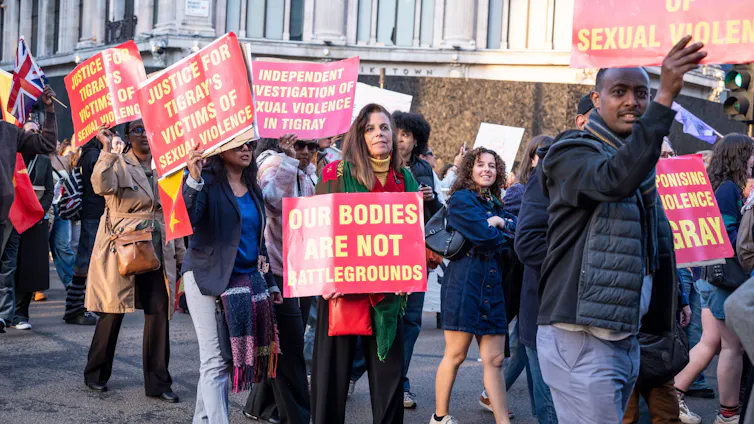 An independent investigation has found widespread use of reproductive violence against women in the bitter civil war that raged in Tigray, northern Ethiopia.
Bjanka Kadic/Alamy Live News
An independent investigation has found widespread use of reproductive violence against women in the bitter civil war that raged in Tigray, northern Ethiopia.
Bjanka Kadic/Alamy Live News
Second, reproductive violence has traditionally been absorbed into sexual violence. This approach has overshadowed reproductive violence as a distinct category. Rape and other sexual crimes have rightly gained attention. But it has also rendered reproductive violence invisible as a distinct category, with its own victims and its own harms.
As Ní Aoláin observed: “While rape in armed conflict makes headlines, obstetric violence against women and girls generally does not.”
Third, much reproductive violence operates indirectly and may appear almost routine. A woman who miscarries because a maternity ward was bombed has suffered reproductive violence. But there is no direct perpetrator with blood on their hands. The deaths are statistical, diffuse, and emerge over time.
Making the invisible visible
Addressing reproductive violence requires first understanding it. A key obstacle has been conceptual: existing definitions fail to unpack its different harms. While forced pregnancy, castration and forced abortion are all reproductive violence, they affect victims in very different ways.
Research I have published in the International Journal of Transitional Justice develops a new typology. It categorises reproductive violence by its consequences for victims.
Birth-compelling harms force unwanted pregnancies. Birth-preventing harms deprive victims of reproductive capacity. Birth-endangering or terminating harms endanger wanted pregnancies or destroy health infrastructure.
This typology matters for three reasons. It makes visible the distinct harms each category inflicts. It helps investigators spot seemingly isolated acts as part of a concerted plan. And it strengthens the case for accountability under international law.
Recognition is slowly emerging. Today, more organisations treat reproductive violence as a distinct form of gender-based violence. But recognition requires deeper understanding of why reproductive violence occurs and its effects on victims. For too long, the law has treated this violence as incidental to mass atrocities rather than central to their execution.
Perpetrators have always known otherwise: control over whether a people can have children is control over whether that people will exist at all.
- Sexual violence
- Uyghurs
- Tigray war
- Ukraine invasion 2022
- Israeli-Palestinian conflict
Events
Jobs
-
 RMIT EOI for Aboriginal & Torres Strait Islander peoples
-
University Librarian
-
Video Commissioning Editor
-
Postdoctoral Research Fellow or Research Fellow
-
Lecturer / Sr. Lecturer / A/Professor in Statistics for Omics
 RMIT EOI for Aboriginal & Torres Strait Islander peoples
 University Librarian
 Video Commissioning Editor
 Postdoctoral Research Fellow or Research Fellow
 Lecturer / Sr. Lecturer / A/Professor in Statistics for Omics
- Editorial Policies
- Community standards
- Republishing guidelines
- Analytics
- Our feeds
- Get newsletter
- Who we are
- Our charter
- Our team
- Partners and funders
- Resource for media
- Contact us
-
-
-
-
Copyright © 2010–2026, The Conversation